
How Automatic Padel Booking Works at Release
See how automatic padel booking works: select your court, let the system race at release time, approve payment if needed, and get the result instantly.
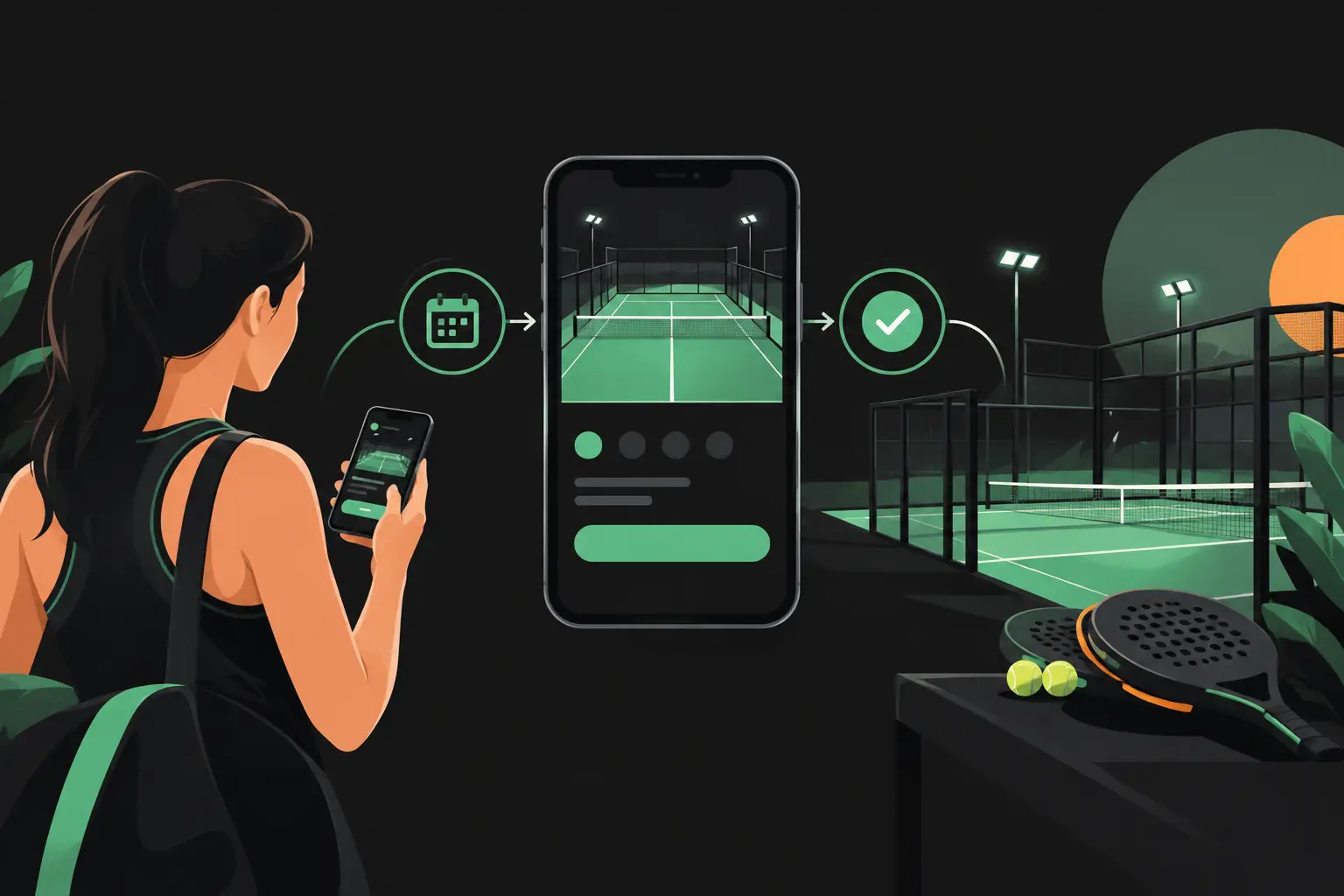
Your group is ready. The court is not. At midnight, or whenever your club opens its diary, the same race starts: refresh Playtomic, tap quickly, hope the app loads, and watch your preferred court vanish. That is exactly how automatic padel booking works differently. Instead of asking you to win a release-time scramble with your thumbs, it prepares the request in advance and fires it the moment booking opens.
For players who arrange the same weekly game, that difference is more than convenient. It is the difference between Court 3 at 7pm and a late slot nobody wants - or no game at all.
How automatic padel booking works
Automatic booking is built around one simple job: reserve the exact court you want when it becomes available, faster than manual booking allows.
You set up a request before the release time. Choose the club, date, start time, duration and preferred court number. The system then watches for the moment that slot is released on the supported booking platform. When availability appears, it submits the reservation through your own account straight away.
With Padel Goose, that means Playtomic requests are timed against a synchronised server clock rather than the clock on your phone. There is no relying on a late notification, patchy mobile signal or a frantic sequence of refreshes. The system is ready to race when the club opens the slot.
The target is specific. You are not merely asking for any court at any time. You can request the court that suits your group, whether that is the court nearest the changing rooms, the one with the best lighting, or simply the one you always play on.
Step 1: Choose the court worth winning
The best time to make a booking request is well before your club's release window. By then, you should know the details that matter: the club, playing date, start time, duration and court number.
This specificity matters at high-demand clubs. A generic availability search can leave you with a court at an awkward hour or force your group to reshuffle plans. Automatic booking is designed for the player who already knows what they want and does not want to compromise because someone else tapped faster.
There is a trade-off. Requesting one exact court gives you the strongest chance of securing that court, but it also means there is no automatic switch to a different court if your chosen one has gone. If flexibility matters more than a particular court number, it may make sense to create requests for acceptable alternatives where available. If Court 2 is non-negotiable, keep the request focused and let the system fight for Court 2.
Step 2: The system waits for the true release time
Manual booking usually fails in the smallest gaps. You refresh a fraction too early and see nothing. You refresh again, sign in, select the session and reach checkout after another player has already grabbed the slot.
Automated booking removes those repeated human steps from the release moment. Your booking details are prepared in advance, while server-clock synchronisation tracks the opening time accurately. When the slot is released, the reservation process is executed with a reaction time of under 100 milliseconds.
That does not mean a booking is magically guaranteed. Clubs can have limited capacity, platform delays can occur, and other players may be using fast methods too. But it does mean your request is not held back by unlocking your phone, refreshing an app or navigating a checkout screen under pressure. It beats manual booking where manual booking is weakest: the first seconds.
Step 3: Your Playtomic account completes the reservation
Automatic booking still uses your supported booking-platform account. The system does not create a mystery reservation outside the club's usual process. It submits the booking through your Playtomic account, using the details needed to complete the request.
That is why account handling matters. Credentials must be stored and used securely, not passed around casually or left in a shared group chat. Padel Goose uses encrypted credential handling so your account information can be used for the booking task without becoming another thing you need to manage at release time.
The practical benefit is straightforward: you stay in control of the booking preferences, while the repetitive, time-critical execution is handled for you. Your mates can argue about who brings the balls. You do not need to spend midnight staring at a loading spinner.
Step 4: Be ready for payment authentication
The one part no booking tool can always complete on your behalf is a bank check. Some card payments trigger 3-D Secure or another authentication step. Your bank may ask you to approve the payment in its app, enter a code or confirm that the purchase is yours.
When that happens, speed still matters. Keep your phone nearby around the release time and make sure bank notifications are enabled. Approve the payment as soon as it arrives so the reservation can finish without losing momentum.
This is not a flaw in automatic booking. It is a security control set by your bank or card provider. A good service should make that clear before you submit a request, rather than pretending every payment can be completed without you. Automation wins the race to reserve the court; you may still need to give the bank the green light.
Step 5: Get the booking result without guessing
After the request runs, you receive a live booking-status update. You should not have to keep reopening Playtomic and wondering whether the court is yours, whether payment is waiting or whether the slot was missed.
A successful result means the requested court has been secured. If it is unsuccessful, you know quickly enough to consider another time, court or plan for the group. That clarity is useful when four people are waiting for you to confirm whether Tuesday night padel is on.
The service is outcome-based too. Creating a request is free. The concierge fee is charged only if the requested court is successfully secured: £5 in Great Britain, or the equivalent €6 or $7 where applicable. You are paying for a win, not for the chance to join another queue.
Why automatic booking is strongest for recurring games
One-off games can be flexible. Recurring games are usually not. A Tuesday evening group may have school runs, work commitments and players travelling from different parts of town. Losing the usual slot can mean a week without a match.
That makes release-time booking a task worth outsourcing. If the same court, same time and same club keep selling out, manual booking asks you to be available at the exact second every week. Automated booking turns that recurring hassle into a prepared request.
It also reduces the social admin. Instead of sending, “I tried but it went,” you can set the request, stay reachable for any bank approval, and share a clear result with the group. Less chasing. More playing.
Common questions about automatic padel booking
Is automatic booking guaranteed to get the court?
No. Demand, platform conditions and competing bookings still matter. The advantage is speed and preparation: the system submits your exact request at release time without the delay of manual tapping.
Can it book a particular court number?
Yes. That is one of the key benefits. Select the preferred court as part of the request rather than settling for whichever court appears first.
Do I need to stay awake at the release time?
Not to refresh and race through the booking flow. You should, however, remain reachable if your bank asks you to approve a 3-D Secure or other payment authentication request.
What happens if the payment needs approval?
You receive the bank's usual prompt and need to approve it promptly. Once approved, the booking can proceed through the normal payment process.
Is there a charge if the court is not secured?
No. The concierge fee applies only to a successful booking. If the requested court is not won, there is no success fee.
The next time your prime slot opens, do not make your game depend on who can refresh an app fastest. Set the exact request early, keep your phone ready for your bank if needed, and let the booking race be run properly.
Ready to stop refreshing Playtomic at release time?
Book a court automatically